MINISTERING TO BUILD UP THE BODY OF CHRIST
 What is the driving principle of the Church... and your church? Is it just getting people saved, out of hell and into heaven when they die? Is it some kind of “eternal fire insurance?” As you read in our article "HOW MANY DISABLED PEOPLE ATTEND YOUR CHURCH?," the purpose of the Church is to grow up in the faith, to become holy, mature Christians. How? – by ministering to build up the Body of Christ. The word "minister" in Greek also means "serve" – to be a "bondservant" which is someone who willingly binds himself to serve his master. And our Master, the Lord Jesus Christ, taught His disciples how to serve / minister to "the poor, maimed, blind, and lame." This was His main target audience, as should be ours too!
In the article “HOW MANY DISABLED PEOPLE ATTEND YOUR CHURCH?” you can see several links to Scripture passages that clearly explain how this is supposed to work. St. Paul uses the word “edify,” a metaphor of construction, building an edifice, to tell us that the Church is like the Old Testament Temple building: we are supposed to be building something for those who are Christ’s target audience, "the poor, maimed, blind, and lame," to enable and empower them so they too can be restored to fullness of life – maturity in Christ.
BUILDING THE ARC: |
(Click Here to see our 5 sketches in full-screen mode.)
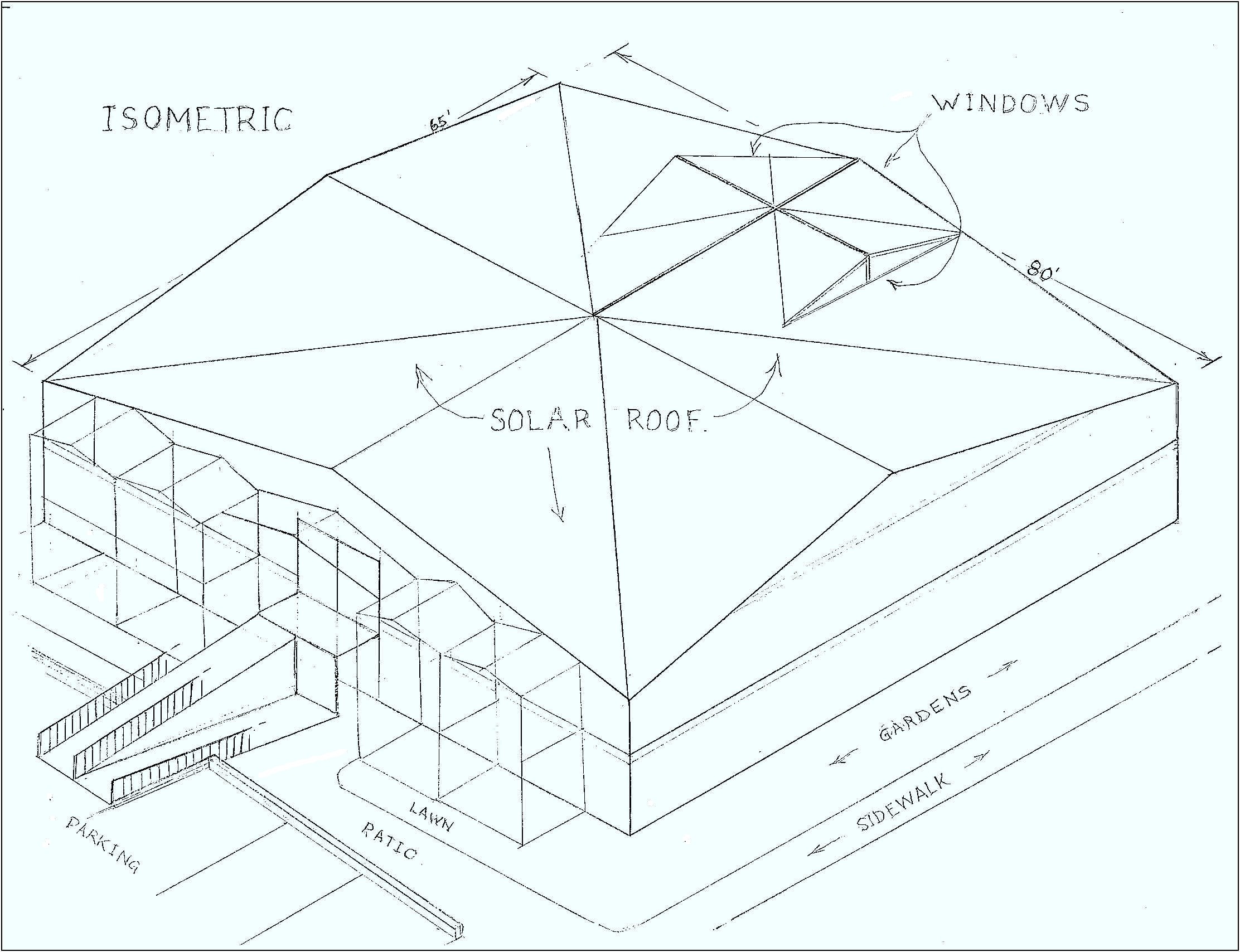 From the outset it is important to stress the need for local self-sufficiency in our Agape Restoration Communities. Although it is not necessarily harmful to help support poor and disabled people (2 Cor. 8:13-15), it must be done in a way that does not create dependency. Therefore we emphasize that local churches should be primarily responsible for their local branch of Agape Restoration Society. One of ARS's goals is to help local churches find a way to have their own meeting place, in a co-operative living center. In each Agape Restoration Community the church will own shares for the community room/chapel and restrooms, and the residents will own shares for their living unit. In our simplified plans we show up to 12 wheelchair-accessible living units or classrooms.
Each center will be organized as an autonomous branch of the ARS, associated with a local church, and will be responsible for its own local fund-raising and repaying loans from various sources. Local funds will be kept in local bank accounts until expended. Close supervision of and accounting for disbursing funds will insure that they are used strictly as designated and disbursed only when services have been performed. Each local branch of the ARS will be encouraged to train and send workers to help start new branches, and as its loans are paid off, to loan money interest-free to these new branches. Here's how you can donate for this project and/or join our mail list. Thanks!
Secularism has led to the de-Christianizing of the world. Former church buildings in the U.S. have been turned into taverns or private residences. In its extreme form of communism, about 250,000 church buildings in Russia were destroyed or confiscated and turned into breweries, warehouses, or "Lenin Houses of Culture." Secularization world-wide has diminished the role of the church in society and has led most people to lean on the state for answers to all their problems, leaving many churches shrinking or abandoned. Poor and disabled Christians must free themselves from the idea that "they" – meaning someone else: the state or other Christians – ought to pay to restore or build new churches. Secular governments have neither the wealth nor the will to pay for this, and there is not enough money in all the churches and other Christian organizations in the whole world to build the needed number of ordinary church buildings so that our countries can again be called "Christian nations."
But almost all Christians, including poor and disabled people, have a place to live. By exchanging their current home for a living unit in an ARC, they are providing a building where a church can gather to worship and fulfill its God-ordained ministry to "the poor, the maimed, the lame and the blind." Christians already have the wealth needed to carry out the task of re-Christianizing their countries, in the form of their current homes. We need to restore the spirit of agape-love and mutual self-help community, then simply train and organize ourselves to do it.
A pastor or deacon of the associated church will serve as director of the local ARC branch. The director of ARS or director of a local branch (or a relative) must not control the finances: a completely separate person must manage the finances of each local ARC, separate from the church's finances. When a sufficient number of people have subscribed for shares, the local branch can take out a construction loan to build a new Agape Restoration Community. When a family sells its old house or apartment, the money from the sale of the old residence will be used to pay for its shares in the new ARC. Thus it is self-financing.
The ARC and its associated church will be two separate legal entities. Other people can be members of this church and not of the ARC "housing cooperative." The church associated with each ARC, represented by its clergy, is also a member of the ARC. Residents will be members of this cooperative that requires all adult residents of sound mind to be members of the church and affirm its doctrines and practices. This guarantees the building's perpetual Christian character by avoiding the problem of unbelievers in the second generation inheriting the units. A company that has built over 25 housing cooperatives in the Midwest U.S. for disabled persons and seniors, Realife, Inc., takes a similar approach. Here is what their old website stated –
What is a Housing Cooperative?
* Housing cooperatives are a form of multifamily homeownership. Shareholders or tenants join together to form a not-for-profit cooperative corporation which owns the building in which they live.
* Residents buy a share (membership) in the co-op, but the cooperative owns the building, land, and any common areas. Residents are entitled to live in a housing unit as part of their membership benefits.
* Members pay a fixed amount each month that covers basic expenses, including mortgage, property taxes, and maintenance. As share owners, members exercise control over their housing situation by electing a board of directors made up of other residents.
* This varies from a condominium or town home, where residents each own their individual housing units and are responsible for their own mortgage.What are the Advantages?
Ownership: Members actually own the cooperative through their share ownership of the not-for-profit cooperative corporation; there is no equity investor or landlord.
Control: Residents govern the cooperative with assistance from the managing agent.
Cost of Operation: Occupancy charges are equal to only the actual cost of owning and operating the property. In a rental, rent generally goes up faster than actual costs because most landlords are in business to make a profit.
Individuality: Initial members are able to customize their dwelling units, including a choice of floor coverings, cabinet colors, and various structural changes.
Homeowner Tax Advantages: Mortgage interest and real estate taxes are tax deductible in a housing cooperative.
Equity Growth Potential: In a Realife Cooperative, members earn limited equity on their unit based on the amount of time they live in their home. The earning of limited equity keeps it affordable for the first members and future members.
Overall Value: Expenses in a cooperative are spread across the entire membership proportionately, making the cost of living generally lower than a comparable single-family home.Three Steps to Your Cooperative Home
1. Reservation: By making a $500 refundable deposit, you are assigned a reservation number. This determines the order we follow with home selection.
2. Subscription: This is the home selection process. It involves unit selection (including type and location in the building) as well as a review of the costs associated with membership in the cooperative (share price and monthly fee). There is a $4500 down payment required to select the size of your living unit.
3. Share Collection: We collect the shares prior to construction. This is similar to a down payment on a single family home. We are required to collect the shares before we begin construction in return for the FHA insurance on the mortgage. There is only one mortgage on the property and it is held by the cooperative.
(The above dollar amounts are adjusted from the Realife website in the early 2000s to reflect that the dollar is worth less than half as much as then.) Thus we have the four stages needed to start such a housing cooperative:
First, train a diakonia-ministry team to visit and care for local disabled people in their homes.
Second, invite their relatives and friends to come to the home of these disabled people to listen to what the Bible says about caring for the poor, lame, maimed and blind: they already know what you're doing, you just need to identify why you're doing it and many will believe!
Third, when you have three or four of these home groups going (it may take several months to get to know and trust each other, so be patient!), only then introduce to them the idea of a housing cooperative. If you dump this idea on them before you've won their trust you could alienate them, and you need to be able to trust their sincerity as well.
Fourth, when enough people are interested you will incorporate a non-profit housing cooperative, locate a piece of land and follow the three steps above: reservation, subscription and share collection. As you can see, this differs little from conventional church-planting, but it has the added plus of real, hands-on ministry integrated into it right from the start.
The cooperative will consist of about 1/3 of living units for physically healthy families with an adopted or foster child to live in the center, along with about 1/3 of living units for elderly and disabled people and about 1/3 of living units for missionaries and trained volunteer workers, including college students. The larger church body should include mainly people who are capable of ministering, not just those who need to be ministered to. Having physically healthy younger families in the center also greatly helps the rehabilitation of disabled and elderly people and their socialization, because they want and need to be part of the larger, "normal" society.
Participants, both residents and non-residents, will be encouraged to help finish their own living unit and others', and to contribute for common areas. Donors will be able to designate their gifts to go for a specific family or center, and will be kept informed about that family or center. Separately-designated donations will also be raised to provide equipment and medicines for the disabled, as well as to train volunteer workers in a center. Feedback to these donors from each family and center increases their accountability.
Major financial supporters are encouraged to donate or loan money to the building fund so that construction may begin. Shareholders will be responsible for repaying any loans for their living unit, their proportional amount of the center's common facilities, and maintenance fees. Each ARC is locally-owned from the outset. The donors are just donating monthly support which is distributed among local ARS branches, and if a local or the national situation goes bad, they simply stop supporting. This approach reduces the "what if" concerns of donors: "What if some dishonorable person takes over a center?" or "What if a socialist government emerges and nationalizes all property?"
Description of buildings
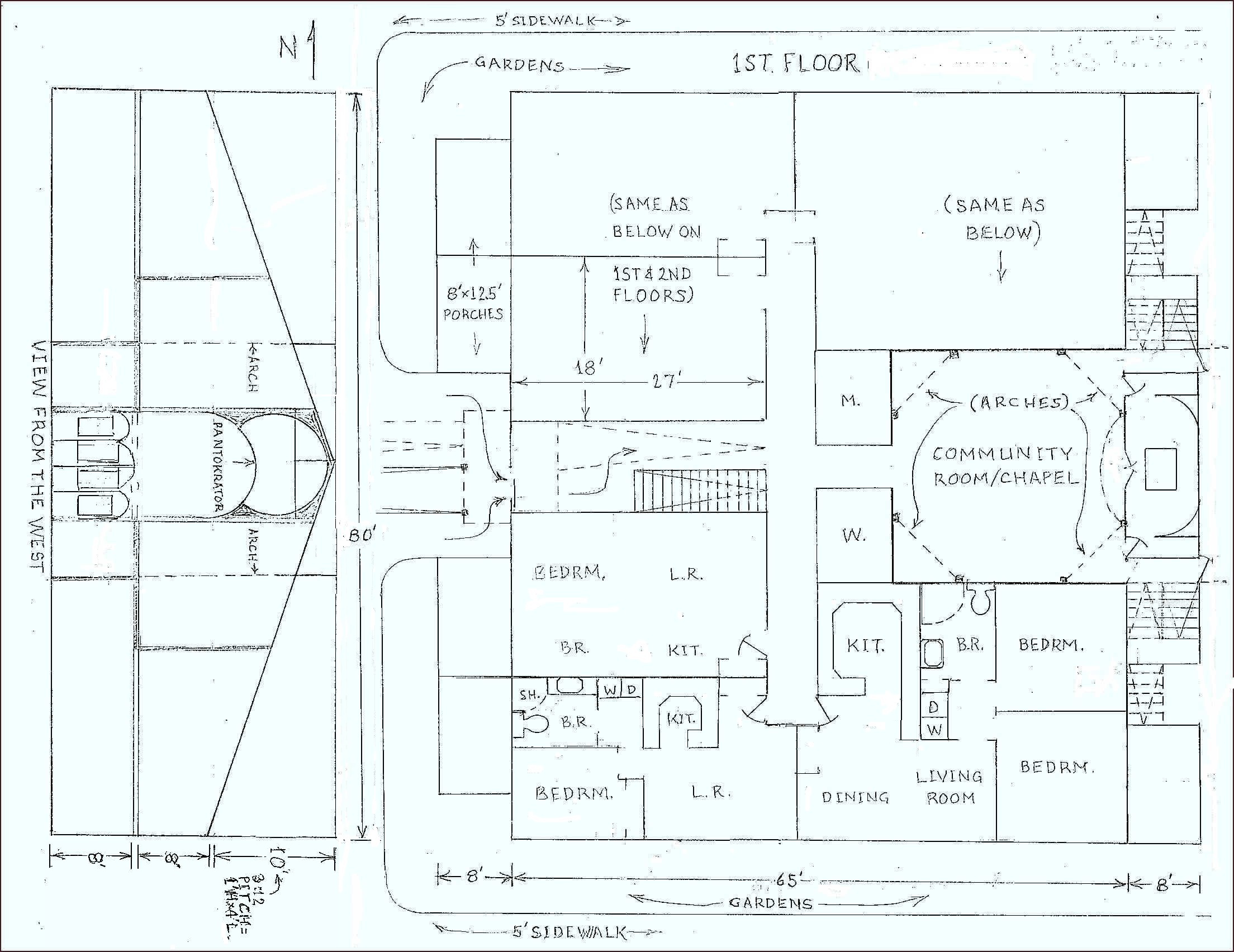
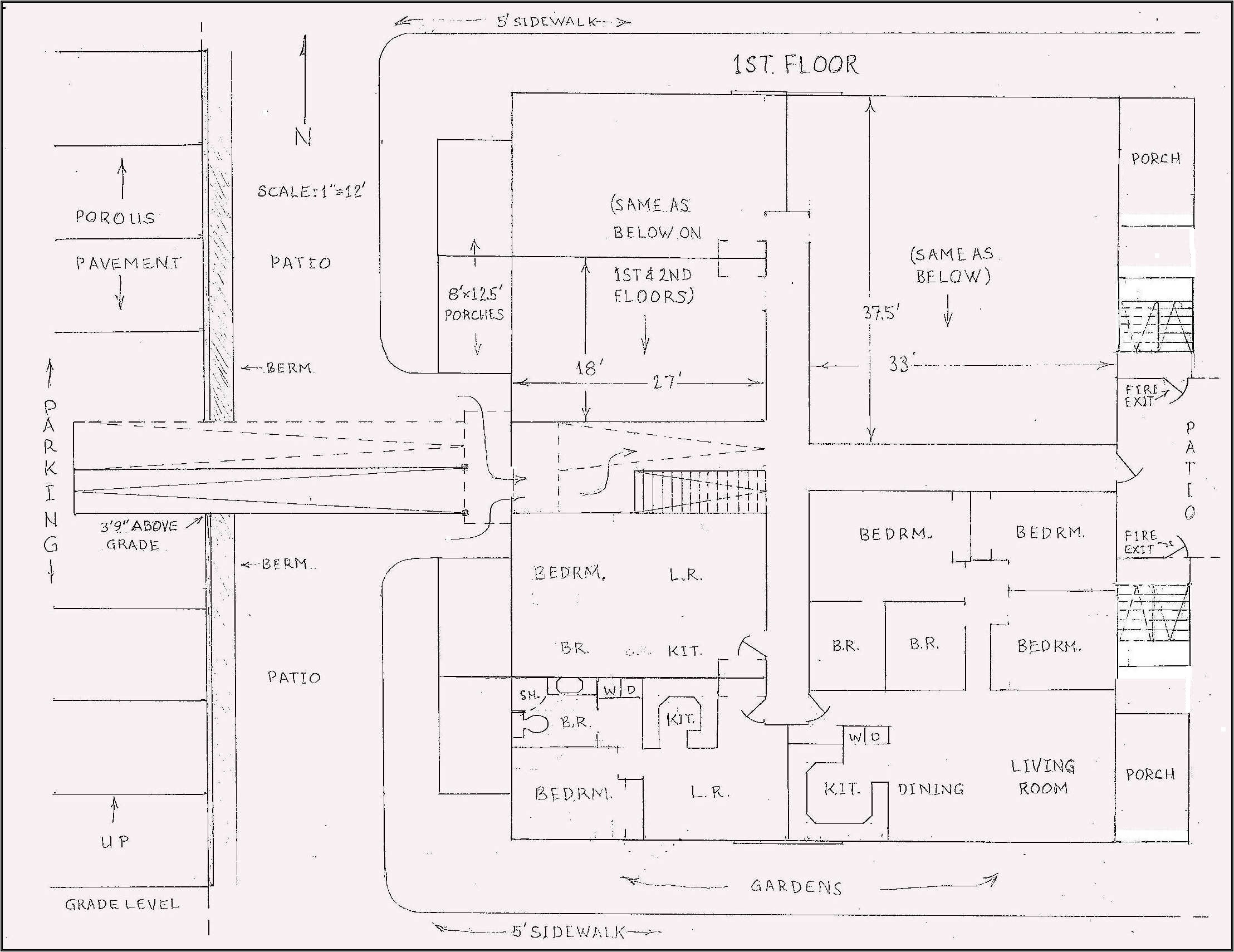
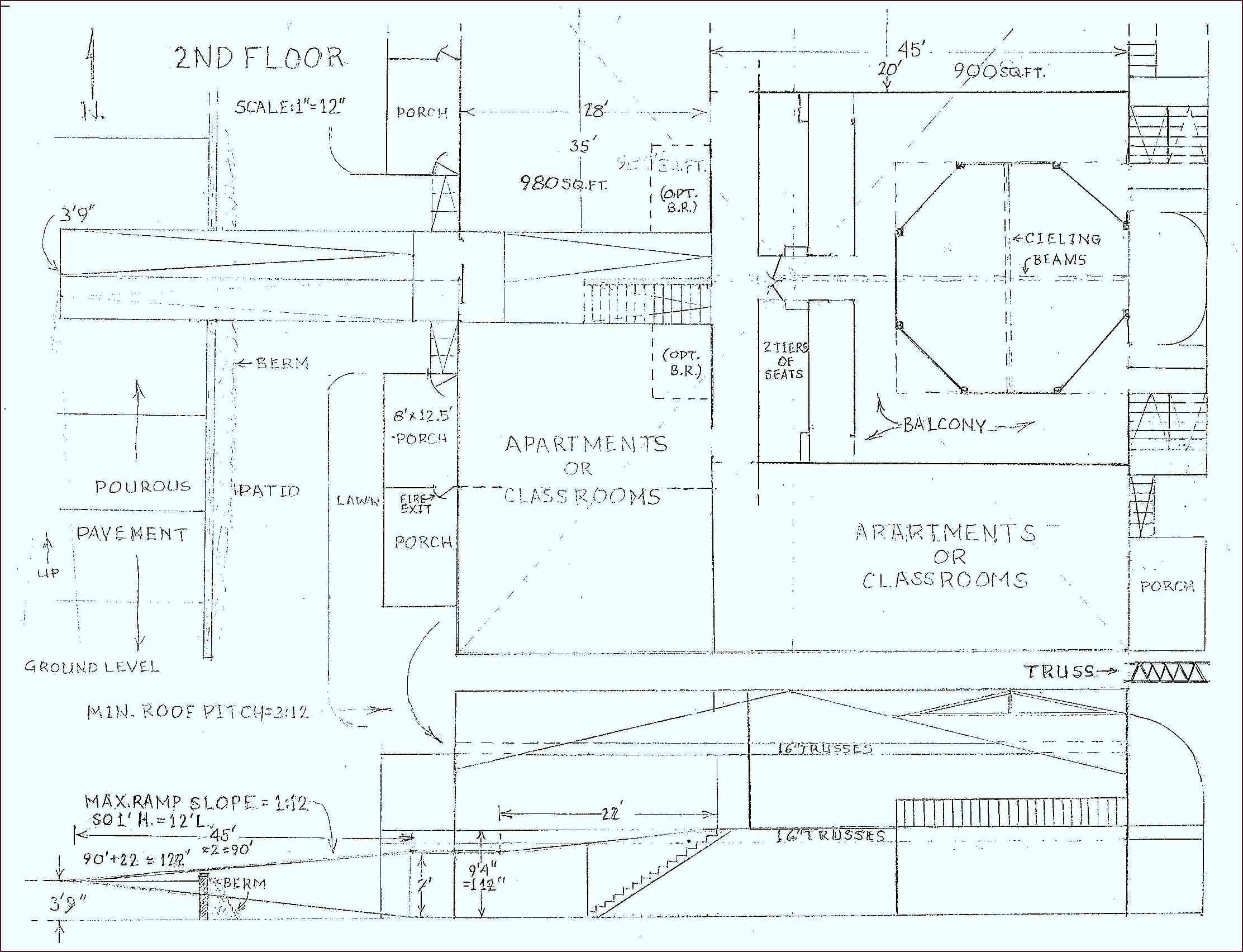
In the plans shown below, you can see how the first and second floors of the center are connected by wheelchair-accessible ramps. The slope of the ramps is very important: the size and shape of the whole building is determined by the slope of the ramps. The slope must be 1:12 (A.D.A. requirement), gentle enough to allow disabled persons with the use of their arms to ascend or descend the ramps by themselves, and there will be special sidewalks outside as well. The community room/chapel on the second floor can be used for physical exercise, shared meals, and other activities. Our earlier ARC #1 drawings showed from 28 to 42 living units, but that would have been quite a large up-front cost, so we've developed plans for an ARC #3 building about 1/4 of that size with 12 living units.
The ARC is kept relatively small to maintain a feeling of "family," a sense of community. The huge apartment complexes in both East and West deprive people of rootedness and the sense of belonging to an "extended family" of like-minded people, and have a harmful effect on family cohesion and the raising of children. Each living unit will have a high-speed connection to the Internet. A larger living unit can be used for a family with many children, or a family that accepts and cares for other handicapped people, or a dormitory for volunteers and students. They can be built in various places in a city, to integrate disabled people into the larger society, rather than isolate them in one part of the city or outside of it. An ARC #3 can be built on 1/2 acre (30m x 50m) with 12 living units and a community room/chapel from 750 to 1,320 sq. ft. for community functions (shared meals, parties, exercise etc.) and worship. To have this center be a self-sustaining community, see https://permaculturism.com/how-much-land-does-it-take-to-feed-one-person/ - about 1/2 acre per person, or 15 acres for 30 people.
Just in Pittsburgh, Pennsylvania, where we now live, or in Ioshkar-Ola, capital of the Mari Republic in Russia, the city in which we lived, could use ten or more of such centers in various places around town. There are thousands of physically disabled people in these cities, many living in housing not built for disabled people. In the U.S., Ukraine, and Russia, both with growing numbers of elderly people, there is a need for hundreds or even thousands of these centers. The disabled people from U.S. wars in Afghanistan and Iraq, or from Russia's wars in Afghanistan, Chechnya, and Ukraine, number in the tens of thousands. This doesn't include people who are disabled from birth, illness or accident. In the U.S. and Russia there are also millions of orphans who need adoption or foster care. These people are among the neediest, because it is difficult for them to receive training adapted to their needs and find well-paying jobs.
Due to changing costs for construction in each locality, even a rough cost estimate of each center is not possible here. But keep in mind that if construction costs change, so does the value of the local homes that future residents will sell to take a living unit in an Agape Restoration Community. The majority of the cost for the entire building will be paid for by the living unit residents and participants in each local branch of ARS. We will need to have these sketches re-drawn by a local architect to meet local building codes. You can see and print out this article including these plans at our Web site https://agape-biblia.org/literatura/ARC-Article-Eng.pdf.
Conclusion
"When the Son of Man comes in His glory, and all the holy angels with Him, then He will sit on the throne of His glory. All the nations will be gathered before Him, and He will separate them one from another, as a shepherd divides his sheep from the goats. And He will set the sheep on His right hand, but the goats on the left. Then the King will say to those on His right hand, 'Come, you blessed of My Father, inherit the kingdom prepared for you from the foundation of the world: for I was hungry and you gave Me food; I was thirsty and you gave Me drink; I was a stranger and you took Me in; I was naked and you clothed Me; I was sick and you visited Me; I was in prison and you came to Me.' Then the righteous will answer Him, saying, 'Lord, when did we see You hungry and feed You, or thirsty and give You drink? When did we see You a stranger and take You in, or naked and clothe You? Or when did we see You sick, or in prison, and come to You?' And the King will answer and say to them, 'Assuredly, I say to you, inasmuch as you did it to one of the least of these My brethren, you did it to Me.'"
- Matthew 25: 31-40
Now, if you'd like to meet others who want to Build the ARC, join "The ARC" Chat/Video Forum!
The ARC #3: (To view these drawings full-screen or print on 8.5" x 11" paper, click on each drawing.)
|
| |
|
| |
|
| |
|
| |
(You can see and print out this article including these plans at our website https://agape-biblia.org/literatura/ARC-Article-Eng.pdf.) You can read our whole newsletter at https://agape-restoration-society.org/ARC-News/a-n_2026-09-26.htm, and share it! Saturday, September 12, 2026A SIX-LANE HIGHWAY, OR A NARROW ROAD WITH TIGHT GATE?
Jesus Christ, our Lord and Master, said: "Enter in by the narrow gate; for wide is the gate and broad is the way that leads to destruction, and many are those who enter in by it. How narrow is the gate, and restricted is the way that leads to life! Few are those who find it." Freedom of choice implies the responsibility to make the right choice and live (or die) with the consequences of our choices. Missing an entrance to or exit from a limited-access highway means turning around and going back to that point of wrong decision... if you can! Some can't find their way back, and others can, for example the Old Testament kings Saul and David. King Saul seemed to have a good start in life: he was tall, handsome, and humble. But after he became king, he grew proud and power-hungry, and finally fell into disobedience to God and His prophet Samuel, then fell into witchcraft. He regretted his sin, but didn't repent and turn his life around. True repentance isn't just regret or feeling sorry. The Greek word for repentance, metanoia, means to turn around 180 degrees and go in a different direction. On the other hand, after King David committed the terrible sins of adultery and ordering a murder, he deeply repented – read all of Psalm 51 – and turned his life around. Nevertheless, he paid a price for his sins. Forgiveness does not mean there are no consequences. Sexual sin, even if God forgives it, can result in infertility, divorce, or sexually transmitted disease. A victim's spouse or God may forgive a murderer who repents, but the sentence can still be carried out. Judas felt regret for betraying Christ, but committed suicide. On the other hand, Peter denied Christ three times but repented of his sin, and the Lord restored him. In 1 Corinthians ch. 6, we read about a man who had committed incest by having sex with his father's wife. St. Paul wrote to the church that he should be excommunicated "for the destruction of his flesh" ...but in 2 Corinthians, Paul instructed the church to restore him to fellowship after he had repented. Back to our starting thoughts: Jesus said – "But truly I tell you, there were many widows in Israel in the days of Elijah, when the sky was shut up three years and six months, when a great famine came over all the land. Elijah was sent to none of them, except to Zarephath, in the land of Sidon, to a woman who was a widow. There were many lepers in Israel in the time of Elisha the prophet, yet not one of them was cleansed, except Naaman, the Syrian" (Luke 4: 25-27). There are some who make the Narrow Road too narrow or the Gate too tight, such as the Jewish leaders who got really angry with Jesus when he said this, and wanted to get rid of Him. There will be olive-skinned Gentiles, black Africans, Chinese, Australian Aborigines... believers from all the Nations in the Kingdom of God. On the other hand, we shouldn't make the Road too wide or the Gate to loose. To believe that all religions lead to God, or that Allah is the same deity as Yahweh, or that all or most of the "Christian" confessions are more or less the same, they all get you into heaven, and that whatever you believe about Jesus is just fine – all such talk is nonsense, a big mistake. It's called "Universalism" which the Church has defined as a heresy. "How narrow is the gate, and restricted is the way that leads to life! Few are those who find it." How narrow is it? We aren't authorized to make up our own 'private interpretation' of Scripture. Holy men of God moved by the Holy Spirit, the Church, the Body of Christ throughout history, gives us the correct interpretaion of this Scripture (1 Peter 1:20-21). At the end of each Orthodox Liturgy we sing – "We have seen the true Light, we have received the heavenly Spirit! We have found the True Faith, worshiping the Holy Trinity, Who has saved us!" This doesn't mean, of course, that each one of us Orthodox Christians have 100% of the fullness of the Faith. The fullness does exist in the Orthodox Church, however, and it's available for all who take the time and effort to strive toward it. You might be thinking – "But there are sinners in the Church!" Yes, there are, that's who the Church is for, it's a hospital for sinners to be made whole. Many are satisfied to have only 60% or 70% of the fullness, but a few are striving for 95% or even 100%. Which are you? "PBPGOINFWMY" doesn't stand for "Peanut Butter Pie, Grapes In Nougat Fudge, With Marshmallow Yoghurt" or any such garbled nonsense – no, it stands for "Please Be Patient, God Is Not Finished With Me Yet!" Come and See! You can read our whole newsletter at https://agape-restoration-society.org/ARC-News/a-n_2026-09-12.htm, and share it!
Subscribe to:
Posts (Atom)
IT'S A MATTER OF AGENCY"IT'S A MATTER OF AGENCY" As I was pondering how to write about the current lack of initiative among many in the Wes... 
|