You really must read the article by the title in my headline! The author asked ChatGPT: "If you were the devil, how would you destroy America’s youth?" Its answers were unsettling and too familiar.
The article consists of these subheadings:
1. Erode Attention and Presence,
2. Confuse Identity and Purpose,
3. Flood Them with Information, Starve Them of Wisdom,
4. Replace Real Relationships with Simulacra,
5. Normalize Hedonism, Pathologize Discipline,
6. Undermine Trust Across Generations,
7. Make Everything a Marketplace, and
Conclusion: Learning from the Red Team.
It details so vividly the way in which our consciousness has been manipulated and altered over the past 3.5 decades, first with the advent of the World-Wide Web, then the mass introduction of smartphones about 20 years ago. Most "Gen Z" young people (not quite as many older people) have succumbed to "brain rot" – they experience "difficulty thinking or concentrating," their attention span is reduced to hardly more than 30 seconds (the time required to watch a Facebook short reel), they continually seek "external approval (likes, followers)," they "feel life is meaningless," and they've grown up without a "binding moral matrix" due to the deliberate absence of positive moral values portrayed in social media posts and short video reels.
One of the most telling paragraphs is as follows – "A child who constructs an adult identity while drawing from a stable and time-tested set of values, beliefs, and stories, given to her by trusted adults within a religious or philosophical tradition, will fare far better than a child who attempts to construct an adult identity by herself while drawing from a billion pieces of short and ephemeral content, produced mostly by young people and bots, which cannot be assembled into a coherent worldview."
ChatGPT ended with this summary: "In short: if I were the devil, I'd destroy the next generation not by terror or violence, but by distraction, disconnection, and slow erosion of meaning. They wouldn't even notice, because it would feel like freedom and entertainment."
How many times every day to you see how people, when standing in a line, sitting in a waiting room, or standing at a bus stop, pull out their phones and stick their noses onto it, ignoring everyone around them? For many folks, the last thing they do before going to sleep at night and the first thing they do as they wake up in the morning is – "gotta check my phone"? Instead of our phone being a useful tool or a servant, we have become its slaves. We have become addicted to our phones for those tiny jolts of dopamine stimuli.
What must be done? Put that phone in your pocket or purse! Don't keep it in your hand or on your desk or counter. Don't glance at it every 5 or 10 minutes "so you won't miss anything" – by constantly checking it, you're missing the most important things of life: spending time with real people. Don't look at it just before bedtime or until at least 10 minutes after you get out of bed! Give your body time to go through the natural rhythm of winding down and starting up. And schedule time every day to read at least several pages from a real, tangible, printed book; not on an e-book reader on your phone or tablet. Most important, spend some time talking with God and interacting face-to-face with real, living human beings, not with ChatGPT.
As I was pondering how to write about the current lack of initiative among many in the West, I came across this headline's article. What does "Agency" really mean? Here are a few excerpts from the article: "Agency is the ability to look at a situation and believe there’s something you can do about it. One of the things I’ve noticed about people with high agency is that they don’t necessarily have better circumstances. They simply see more possibilities within the circumstances they have."
"They don’t necessarily have more resources. They’re often just better at figuring out what to do with the resources in front of them. It’s the way they seemed to view obstacles. The obstacle wasn’t a stop sign. It was a problem to solve. And sometimes solving it meant doing something that wasn’t in the conventional playbook. That’s agency. Agency means thinking for yourself. You can’t give someone agency. You can show them possibilities, challenge their assumptions, help them see another door. They have to decide to walk through it."
For several decades now, young people have been trained to depend on the government and government-funded hospitals, clinics, schools, colleges and universities for things previous generations had to provide for themselves. When I was growing up in the 1950s, we had a large garden that I had to dig up with a shovel to prepare for planting, then pull the weeds, water the garden, and pick the crops, and mow lawns to pay my clothes and school fees: I had my own lawn care business. My Mom canned or froze enormous quantities of food to provide for her six children. She sewed pajamas for us, skirts and dresses for the girls, and shirts for the boys. If we had to go to the doctor or the dentist, we paid cash for it on the spot. We walked to school and back, made and brought our lunches – a sandwich and an apple – to school in a brown paper bag. If we decided to go to college or university, we worked our way through. I started a tailor-made clothing business, got married in a custom-made silk suit, and borrowed only a bare minimum for college so I could pay off the loans in just a few years after graduation.
(← click) In 1912, just before my parents were born, most local public school students were preparing to enter the work force – few continued through 12th grade and even fewer went on to higher education – so by age 13 or 14, they were well-educated to be responsible citizens fully capable of participating in society. I must confess that with my university degree in history, political science, world geography and foreign languages, even I can't answer many of the questions in this 8th grade exam.
But now, many children don't learn basic housekeeping, gardening or hands-on life skills. They can ride a bus for free to and from school, get free breakfasts and lunches in school, subsidized or free "healthcare" – contraceptives and abortions so they can freely "sleep around" with whomever they wish, go to higher education on loans of tens or even over a hundred thousand dollars, sliding through these institutions, many with only "fluff" degrees in subjects that won't provide a living wage. They're spoon-fed 20-second sound bites of pseudo-information on their smartphones to which they're addicted. If they're out of range of WiFi or a cell tower, they become entirely paralyzed, lost and helpless. In short, they haven't aquired agency to think and act on their own.
This dependency on the government was especially impressed on me during our 17 years of missionary service in Russia. People automatically expected some vague "they" to provide all sorts of things and services... for free. A curious feature of the Russian language is the unnamed "They" – one doesn't need to even use the word "They" to start a sentence, simply say: "Ought to give free medical care" or "Should care for the disabled" or "Must provide free education through college or university." The unnamed subject of these sentences was, of course, "The government." As missionaries, we as "rich Westerners" should give them free Bibles, theological training, and financial support for their pastors. So "The West" had replaced "The government" in their thinking. One Russian told me sadly, "We have unlearned how to work."
For several years after we returned from Russia, I volunteered as a job counsellor in low-income neighborhoods. This experience showed me how much unemployed people have "unlearned how to work." Several times, they told me: "All I need is to show the people at the unemployment office that I've applied for 3 jobs, so I can get my check." They have lost their "agency," their adult independence, and have become dependent on the government. That is the norm for many people today. How can this have happened in America?
For centuries after Christ was on earth, His followers practiced genuine Christian "charity" – agape-love. In the KJV version, 1 Cor. 13 uses the word "charity" for "agape" which means divine, selfless love for others. The Apostle Paul, on the way to Jerusalem to be arrested and sent prisoner to Rome, called the elders of the church at Ephesus together and told them – "I coveted no one's silver, or gold, or clothing. You yourselves know that these hands ministered to my necessities, and to those who were with me. In all things I gave you an example, that so laboring you ought to help the weak, and to remember the words of the Lord Yesous, that he himself said, 'It is more blessed to give than to receive'" (Acts 20:33-35). Paul also wrote to the church in Thessalonica – "For even while we were with you, we gave you this command: If anyone is unwilling to work, he shall not eat" (2 Thess. 3:10).
In my article "SEEK THE WELFARE OF THE CITY" you can learn how the Early Church put these teachings into practice by building hospices for the poor and elderly, hospitals for the sick, and orphanages for the street kids. The Church, not the state, balanced Christians' personal charity with individual responsibility and "agency." But in the 7th and 8th centuries Constantinople and much of southern Europe that had been under Christian rule, with the Muslim conquest, Christians were under pressure to adopt Islam. There was a special tax on the "dhimmi," non-Muslims, to either convert or pay this tax. Also, Christians were not allowed to have any social outreach minitries, at best only worship within the four walls of the remaining churches, or at worst... death. And after WW1, with the end of the Ottoman (Muslim Turkish) Empire, communism rose up and began demanding the same sort of submission to the atheistic state.
Today we see that these two worldviews, Marxism and Islam, are becoming more openly allied. You might wonder how an atheistic ideology and a theistic religion could be allies: both share the same spiritual essence – they deny that Jesus Christ is God incarnate. we read in 1 John 4:2-3 – "By this you know the Spirit of God: every spirit who confesses that Jesus is the Christ has come in the flesh is of God, and every spirit who doesn't confess that Jesus is the Christ has come in the flesh is not of God, and this is the spirit of the Antichrist, of whom you have heard that it comes. Now it is in the world already." That shared spirit between Marxism and Islam is the Antichrist.
In the middle of the 20th century, Western society also "flipped the script." In place of church-established schools, hospitals, nursing homes, hospices and orphanages, with the post-war "baby boom" we needed more schools right away and various denominations or local school boards didn't have the funds, so the U.S. government offerred to subsidize the new construction projects. And I distinctly remember in junior high school the government promising they wouldn't interfere with the curriculum of schools. But later they felt the "need" to set up the U.S. Department of Education... and as they say, "the rest is history" – federal "guidelines" were established that soon became rules in order to receive federal aid. In the 1970s, WW2 veterans were retiring, many had war injuries, needed hospitalization, and church-established hospitals couldn't handle the growing needs, so again the government stepped in. Catholic, Presbyterian, Methodist, Lutheran and Baptist hospitals were bought out and became city- and state-owned hospitals. Christianity is being shoved to the sidelines.
So by now, people in the West automatically think that's the way things ought to be: "what is" has morphed to "what ought to be." (Unspoken subject) Ought to give free medical care" or "_______ should provide free education," etc. The default way of thinking now is "let the government do it." And the First Amendment's guarantee of "freedom of religious expression" has morphed into "freedom of religion as long as you keep it to yourself or inside your church building" – just like it was in the Ottoman Empire, the USSR and still is in Russia today. What is the answer? We must be unafraid to boldly confess our faith. We must insist on our God-given right to publicly express in word and action our Christian beliefs and morals! We cannot shrink back! This is why we've developed "The ARC" concept, the Agape Restoration Community.
What is the driving principle of the Church... and your church? Is it just getting people saved, out of hell and into heaven when they die? Is it some kind of “eternal fire insurance?” As you read in our article "HOW MANY DISABLED PEOPLE ATTEND YOUR CHURCH?," the purpose of the Church is to grow up in the faith, to become holy, mature Christians. How? – by ministering to build up the Body of Christ. The word "minister" in Greek also means "serve" – to be a "bondservant" which is someone who willingly binds himself to serve his master. And our Master, the Lord Jesus Christ, taught His disciples how to serve / minister to "the poor, maimed, blind, and lame." This was His main target audience, as should be ours too!
In the article “HOW MANY DISABLED PEOPLE ATTEND YOUR CHURCH?” you can see several links to Scripture passages that clearly explain how this is supposed to work. St. Paul uses the word “edify,” a metaphor of construction, building an edifice, to tell us that the Church is like the Old Testament Temple building: we are supposed to be building something for those who are Christ’s target audience, "the poor, maimed, blind, and lame," to enable and empower them so they too can be restored to fullness of life – maturity in Christ.
BUILDING THE ARC: Personal empowerment via accountability and work
(Click Here to see our 5 sketches in full-screen mode.)
From the outset it is important to stress the need for local self-sufficiency in our Agape Restoration Communities. Although it is not necessarily harmful to help support poor and disabled people (2 Cor. 8:13-15), it must be done in a way that does not create dependency. Therefore we emphasize that local churches should be primarily responsible for their local branch of Agape Restoration Society. One of ARS's goals is to help local churches find a way to have their own meeting place, in a co-operative living center. In each Agape Restoration Community the church will own shares for the community room/chapel and restrooms, and the residents will own shares for their living unit. In our simplified plans we show up to 12 wheelchair-accessible living units or classrooms.
Each center will be organized as an autonomous branch of the ARS, associated with a local church, and will be responsible for its own local fund-raising and repaying loans from various sources. Local funds will be kept in local bank accounts until expended. Close supervision of and accounting for disbursing funds will insure that they are used strictly as designated and disbursed only when services have been performed. Each local branch of the ARS will be encouraged to train and send workers to help start new branches, and as its loans are paid off, to loan money interest-free to these new branches. Here's how you can donate for this project and/or join our mail list. Thanks!
Secularism has led to the de-Christianizing of the world. Former church buildings in the U.S. have been turned into taverns or private residences. In its extreme form of communism, about 250,000 church buildings in Russia were destroyed or confiscated and turned into breweries, warehouses, or "Lenin Houses of Culture." Secularization world-wide has diminished the role of the church in society and has led most people to lean on the state for answers to all their problems, leaving many churches shrinking or abandoned. Poor and disabled Christians must free themselves from the idea that "they" – meaning someone else: the state or other Christians – ought to pay to restore or build new churches. Secular governments have neither the wealth nor the will to pay for this, and there is not enough money in all the churches and other Christian organizations in the whole world to build the needed number of ordinary church buildings so that our countries can again be called "Christian nations."
But almost all Christians, including poor and disabled people, have a place to live. By exchanging their current home for a living unit in an ARC, they are providing a building where a church can gather to worship and fulfill its God-ordained ministry to "the poor, the maimed, the lame and the blind." Christians already have the wealth needed to carry out the task of re-Christianizing their countries, in the form of their current homes. We need to restore the spirit of agape-love and mutual self-help community, then simply train and organize ourselves to do it.
A pastor or deacon of the associated church will serve as director of the local ARC branch. The director of ARS or director of a local branch (or a relative) must not control the finances: a completely separate person must manage the finances of each local ARC, separate from the church's finances. When a sufficient number of people have subscribed for shares, the local branch can take out a construction loan to build a new Agape Restoration Community. When a family sells its old house or apartment, the money from the sale of the old residence will be used to pay for its shares in the new ARC. Thus it is self-financing.
The ARC and its associated church will be two separate legal entities. Other people can be members of this church and not of the ARC "housing cooperative." The church associated with each ARC, represented by its clergy, is also a member of the ARC. Residents will be members of this cooperative that requires all adult residents of sound mind to be members of the church and affirm its doctrines and practices. This guarantees the building's perpetual Christian character by avoiding the problem of unbelievers in the second generation inheriting the units. A company that has built over 25 housing cooperatives in the Midwest U.S. for disabled persons and seniors, Realife, Inc., takes a similar approach. Here is what their old website stated –
What is a Housing Cooperative?
* Housing cooperatives are a form of multifamily homeownership. Shareholders or tenants join together to form a not-for-profit cooperative corporation which owns the building in which they live.
* Residents buy a share (membership) in the co-op, but the cooperative owns the building, land, and any common areas. Residents are entitled to live in a housing unit as part of their membership benefits.
* Members pay a fixed amount each month that covers basic expenses, including mortgage, property taxes, and maintenance. As share owners, members exercise control over their housing situation by electing a board of directors made up of other residents.
* This varies from a condominium or town home, where residents each own their individual housing units and are responsible for their own mortgage.
What are the Advantages? Ownership: Members actually own the cooperative through their share ownership of the not-for-profit cooperative corporation; there is no equity investor or landlord. Control: Residents govern the cooperative with assistance from the managing agent. Cost of Operation: Occupancy charges are equal to only the actual cost of owning and operating the property. In a rental, rent generally goes up faster than actual costs because most landlords are in business to make a profit. Individuality: Initial members are able to customize their dwelling units, including a choice of floor coverings, cabinet colors, and various structural changes. Homeowner Tax Advantages: Mortgage interest and real estate taxes are tax deductible in a housing cooperative. Equity Growth Potential: In a Realife Cooperative, members earn limited equity on their unit based on the amount of time they live in their home. The earning of limited equity keeps it affordable for the first members and future members. Overall Value: Expenses in a cooperative are spread across the entire membership proportionately, making the cost of living generally lower than a comparable single-family home.
Three Steps to Your Cooperative Home 1. Reservation: By making a $500 refundable deposit, you are assigned a reservation number. This determines the order we follow with home selection. 2. Subscription: This is the home selection process. It involves unit selection (including type and location in the building) as well as a review of the costs associated with membership in the cooperative (share price and monthly fee). There is a $4500 down payment required to select the size of your living unit. 3. Share Collection: We collect the shares prior to construction. This is similar to a down payment on a single family home. We are required to collect the shares before we begin construction in return for the FHA insurance on the mortgage. There is only one mortgage on the property and it is held by the cooperative.
(The above dollar amounts are adjusted from the Realife website in the early 2000s to reflect that the dollar is worth less than half as much as then.) Thus we have the four stages needed to start such a housing cooperative: First, train a diakonia-ministry team to visit and care for local disabled people in their homes. Second, invite their relatives and friends to come to the home of these disabled people to listen to what the Bible says about caring for the poor, lame, maimed and blind: they already know what you're doing, you just need to identify why you're doing it and many will believe! Third, when you have three or four of these home groups going (it may take several months to get to know and trust each other, so be patient!), only then introduce to them the idea of a housing cooperative. If you dump this idea on them before you've won their trust you could alienate them, and you need to be able to trust their sincerity as well. Fourth, when enough people are interested you will incorporate a non-profit housing cooperative, locate a piece of land and follow the three steps above: reservation, subscription and share collection. As you can see, this differs little from conventional church-planting, but it has the added plus of real, hands-on ministry integrated into it right from the start.
The cooperative will consist of about 1/3 of living units for physically healthy families with an adopted or foster child to live in the center, along with about 1/3 of living units for elderly and disabled people and about 1/3 of living units for missionaries and trained volunteer workers, including college students. The larger church body should include mainly people who are capable of ministering, not just those who need to be ministered to. Having physically healthy younger families in the center also greatly helps the rehabilitation of disabled and elderly people and their socialization, because they want and need to be part of the larger, "normal" society.
Participants, both residents and non-residents, will be encouraged to help finish their own living unit and others', and to contribute for common areas. Donors will be able to designate their gifts to go for a specific family or center, and will be kept informed about that family or center. Separately-designated donations will also be raised to provide equipment and medicines for the disabled, as well as to train volunteer workers in a center. Feedback to these donors from each family and center increases their accountability.
Major financial supporters are encouraged to donate or loan money to the building fund so that construction may begin. Shareholders will be responsible for repaying any loans for their living unit, their proportional amount of the center's common facilities, and maintenance fees. Each ARC is locally-owned from the outset. The donors are just donating monthly support which is distributed among local ARS branches, and if a local or the national situation goes bad, they simply stop supporting. This approach reduces the "what if" concerns of donors: "What if some dishonorable person takes over a center?" or "What if a socialist government emerges and nationalizes all property?"
Description of buildings
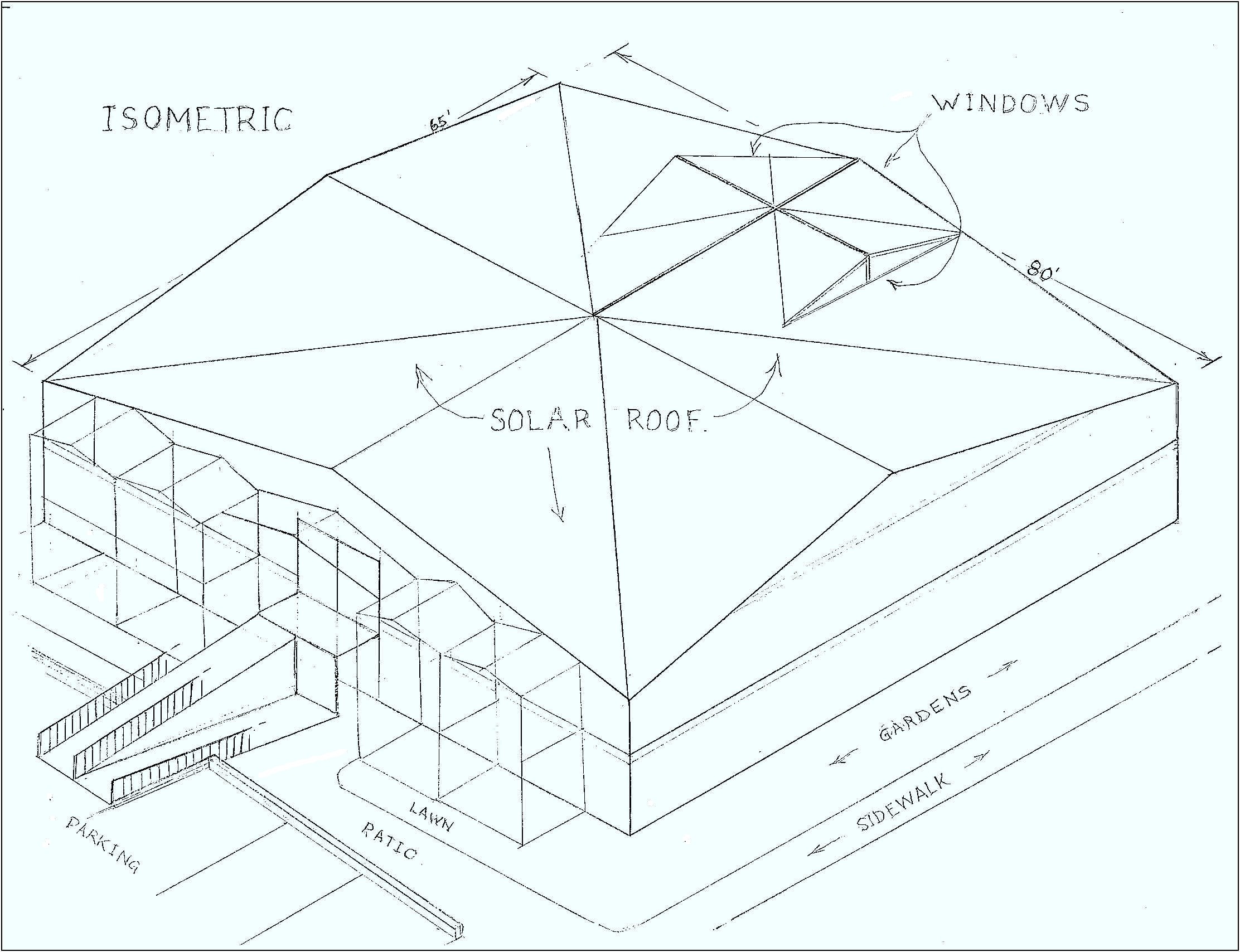
In the plans shown below, you can see how the first and second floors of the center are connected by wheelchair-accessible ramps. The slope of the ramps is very important: the size and shape of the whole building is determined by the slope of the ramps. The slope must be 1:12 (A.D.A. requirement), gentle enough to allow disabled persons with the use of their arms to ascend or descend the ramps by themselves, and there will be special sidewalks outside as well. The community room/chapel on the second floor can be used for physical exercise, shared meals, and other activities. Our earlier ARC #1 drawings showed from 28 to 42 living units, but that would have been quite a large up-front cost, so we've developed plans for an ARC #3 building about 1/4 of that size with 12 living units.
The ARC is kept relatively small to maintain a feeling of "family," a sense of community. The huge apartment complexes in both East and West deprive people of rootedness and the sense of belonging to an "extended family" of like-minded people, and have a harmful effect on family cohesion and the raising of children. Each living unit will have a high-speed connection to the Internet. A larger living unit can be used for a family with many children, or a family that accepts and cares for other handicapped people, or a dormitory for volunteers and students. They can be built in various places in a city, to integrate disabled people into the larger society, rather than isolate them in one part of the city or outside of it. An ARC #3 can be built on 1/2 acre (30m x 50m) with 12 living units and a community room/chapel from 750 to 1,320 sq. ft. for community functions (shared meals, parties, exercise etc.) and worship. To have this center be a self-sustaining community, see https://permaculturism.com/how-much-land-does-it-take-to-feed-one-person/ - about 1/2 acre per person, or 15 acres for 30 people.
Just in Pittsburgh, Pennsylvania, where we now live, or in Ioshkar-Ola, capital of the Mari Republic in Russia, the city in which we lived, could use ten or more of such centers in various places around town. There are thousands of physically disabled people in these cities, many living in housing not built for disabled people. In the U.S., Ukraine, and Russia, both with growing numbers of elderly people, there is a need for hundreds or even thousands of these centers. The disabled people from U.S. wars in Afghanistan and Iraq, or from Russia's wars in Afghanistan, Chechnya, and Ukraine, number in the tens of thousands. This doesn't include people who are disabled from birth, illness or accident. In the U.S. and Russia there are also millions of orphans who need adoption or foster care. These people are among the neediest, because it is difficult for them to receive training adapted to their needs and find well-paying jobs.
Due to changing costs for construction in each locality, even a rough cost estimate of each center is not possible here. But keep in mind that if construction costs change, so does the value of the local homes that future residents will sell to take a living unit in an Agape Restoration Community. The majority of the cost for the entire building will be paid for by the living unit residents and participants in each local branch of ARS. We will need to have these sketches re-drawn by a local architect to meet local building codes. You can see and print out this article including these plans at our Web site https://agape-biblia.org/literatura/ARC-Article-Eng.pdf.
Conclusion
"When the Son of Man comes in His glory, and all the holy angels with Him, then He will sit on the throne of His glory. All the nations will be gathered before Him, and He will separate them one from another, as a shepherd divides his sheep from the goats. And He will set the sheep on His right hand, but the goats on the left. Then the King will say to those on His right hand, 'Come, you blessed of My Father, inherit the kingdom prepared for you from the foundation of the world: for I was hungry and you gave Me food; I was thirsty and you gave Me drink; I was a stranger and you took Me in; I was naked and you clothed Me; I was sick and you visited Me; I was in prison and you came to Me.' Then the righteous will answer Him, saying, 'Lord, when did we see You hungry and feed You, or thirsty and give You drink? When did we see You a stranger and take You in, or naked and clothe You? Or when did we see You sick, or in prison, and come to You?' And the King will answer and say to them, 'Assuredly, I say to you, inasmuch as you did it to one of the least of these My brethren, you did it to Me.'"
The ARC #3: (To view these drawings full-screen or print on 8.5" x 11" paper, click on each drawing.)
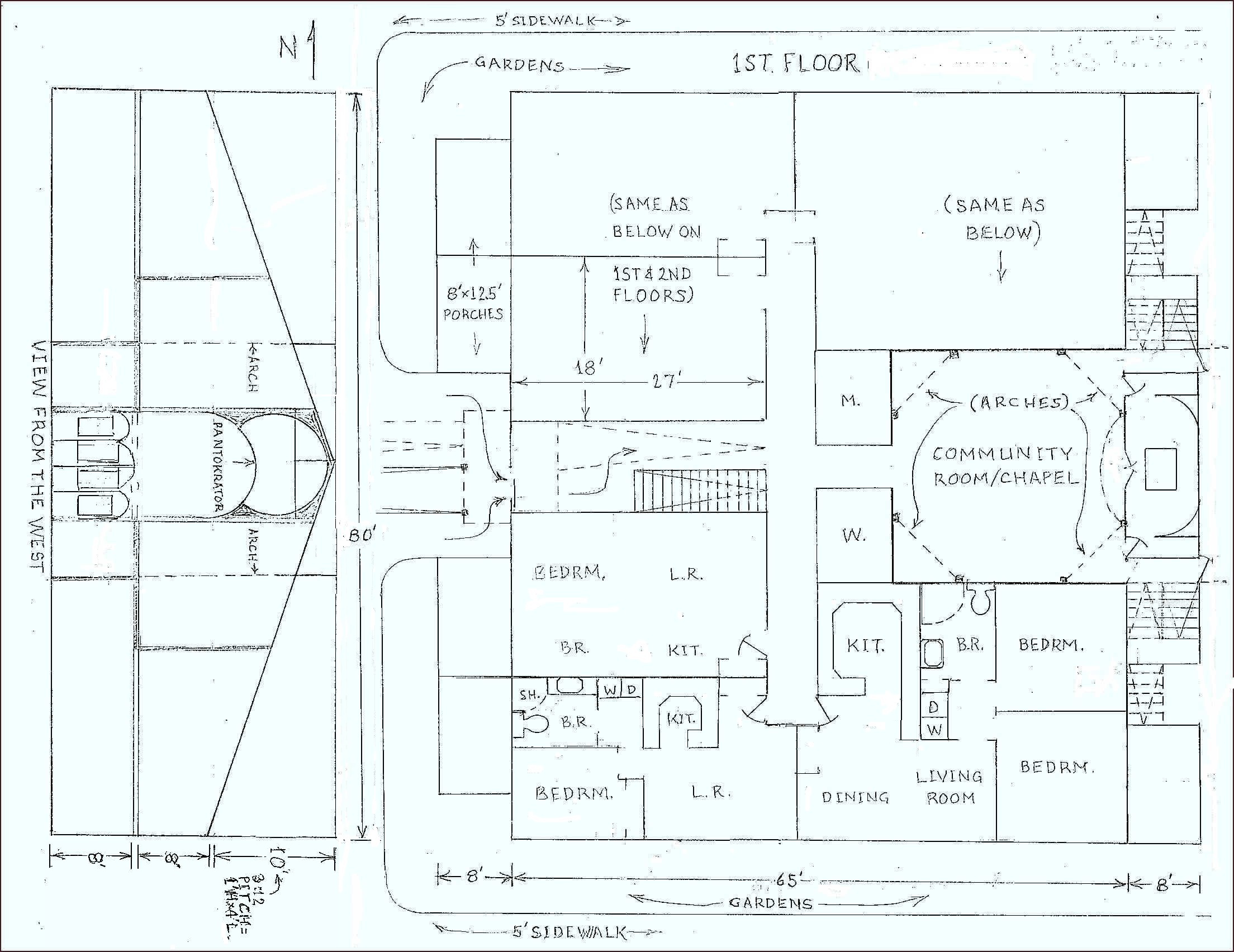
Isometric (three-dimensional) view of ARC #3: Because the building must be wheelchair-accessible there are no steps leading into it, therefore the plot must be landscaped so that water flows away from the building. But most importantly, the design expresses the purpose of the ministry driven church where every member is a minister so they can focus on ministering to people, not on struggling to build and maintain a budget-breaking building. The ARC-3 is built on 1/2 acre with 12 living units, a community room/chapel, and ramps for the building to be wheelchair-accessible. This building is 84' on the east and west sides and 68' on the north and south sides + 16' for the enclosed porches.
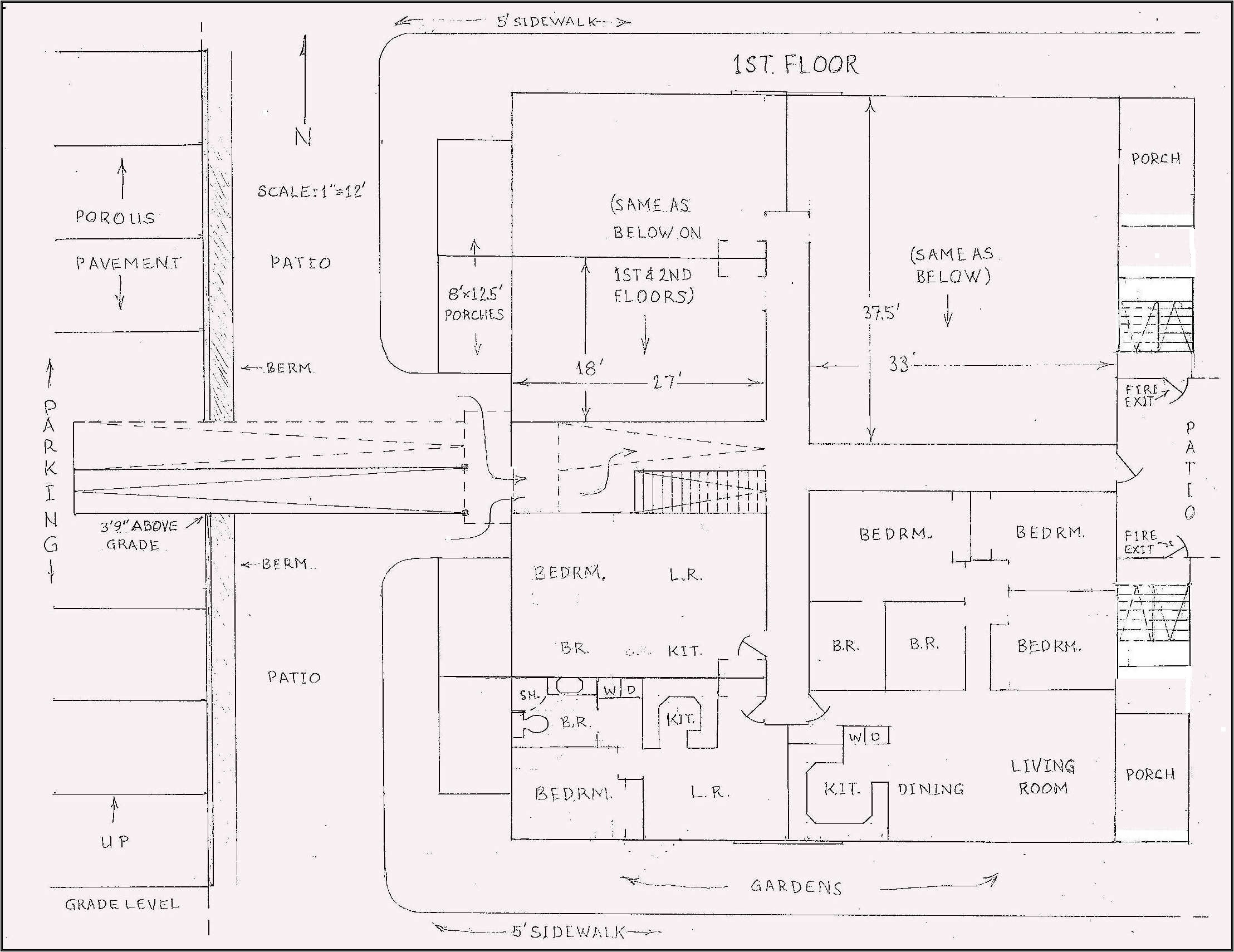
Floorplan for first floor of ARC#3: This floorplan shows two large 3-bedroom units, four 1-bedroom units on the 1st floor, and visitor bathrooms. Ramps embody the goal of restoration: help people restore strength by staying active, also providing full access to the second floor in the event of power failure. The parking area slopes up to 3' 9" above grade level where it connects to the ramps. Two sets of two sliding doors with airlocks, one set for the lower and one for the upper entrance, provide airlocks to limit the loss of heating and cooling the inside.
Alternate floorplan for ARC #3 first floor: This floorplan shows six living units, including two 3-bedroom living units on the 1st floor, to allow for larger families. If choosing this floorplan for the first floor, you can either move the community room/chapel and 2-betroom living units to the second floor, or combine the 25' x 25' space for community room/chapel plus the altar area with the 33' x 41' balcony shown as 2nd floor.
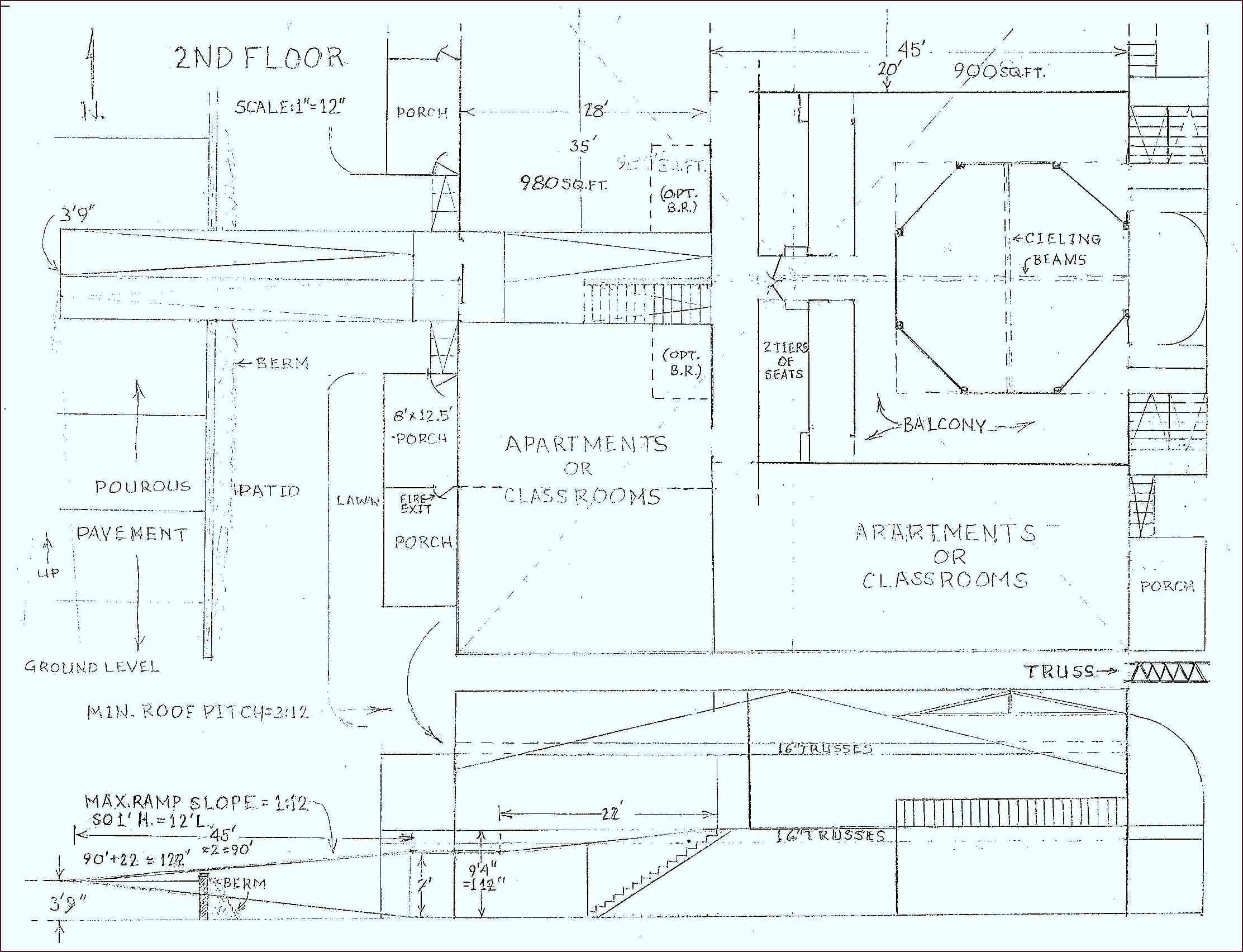
Floorplan for ARC #3 second floor: This floorplan shows six living units on the 2nd floor and a 33' x 40' community room/chapel. The maximum slope is 1:12 for wheelchair-accessible ramps. Both floors have 8-ft. ceilings, and the 16" trusses between floors add 16 inches; so this equals 112”, meaning that the full length of the ramps must be at least 112’. From these dimensions we can calculate the necessary length of ramp and stairways. An elevator to the 2nd floor and choir loft is optional. The 16" trusses between floors are stronger than 2" x 12" beams and provide space for electrical, ventilation, and plumbing runs.
Top and side views for ARC #3. The shaded areas indicate gold-colored paint, tracing the outline of a gold dome. The side views show the ramp slope and how the ramp as it reaches the building allows for a 7'' high entry, then continues up to the 2nd floor that is 9'4" higher than the 1st floor.
A SIX-LANE HIGHWAY, OR A NARROW ROAD WITH TIGHT GATE?
(Click the pic!) We in the West love to think that we have freedom of religion – the right to choose what to believe, as if life is like a six-lane highway where you can get on and off whenever and wherever you want. But is it really like that? Even a six-lane highway has limited access and exit points; just so, freedom isn't unlimited.
Jesus Christ, our Lord and Master, said: "Enter in by the narrow gate; for wide is the gate and broad is the way that leads to destruction, and many are those who enter in by it. How narrow is the gate, and restricted is the way that leads to life! Few are those who find it." Freedom of choice implies the responsibility to make the right choice and live (or die) with the consequences of our choices. Missing an entrance to or exit from a limited-access highway means turning around and going back to that point of wrong decision... if you can! Some can't find their way back, and others can, for example the Old Testament kings Saul and David.
King Saul seemed to have a good start in life: he was tall, handsome, and humble. But after he became king, he grew proud and power-hungry, and finally fell into disobedience to God and His prophet Samuel, then fell into witchcraft. He regretted his sin, but didn't repent and turn his life around. True repentance isn't just regret or feeling sorry. The Greek word for repentance, metanoia, means to turn around 180 degrees and go in a different direction.
On the other hand, after King David committed the terrible sins of adultery and ordering a murder, he deeply repented – read all of Psalm 51 – and turned his life around. Nevertheless, he paid a price for his sins. Forgiveness does not mean there are no consequences. Sexual sin, even if God forgives it, can result in infertility, divorce, or sexually transmitted disease. A victim's spouse or God may forgive a murderer who repents, but the sentence can still be carried out.
Judas felt regret for betraying Christ, but committed suicide. On the other hand, Peter denied Christ three times but repented of his sin, and the Lord restored him. In 1 Corinthians ch. 6, we read about a man who had committed incest by having sex with his father's wife. St. Paul wrote to the church that he should be excommunicated "for the destruction of his flesh" ...but in 2 Corinthians, Paul instructed the church to restore him to fellowship after he had repented.
Back to our starting thoughts: Jesus said – "But truly I tell you, there were many widows in Israel in the days of Elijah, when the sky was shut up three years and six months, when a great famine came over all the land. Elijah was sent to none of them, except to Zarephath, in the land of Sidon, to a woman who was a widow. There were many lepers in Israel in the time of Elisha the prophet, yet not one of them was cleansed, except Naaman, the Syrian" (Luke 4: 25-27). There are some who make the Narrow Road too narrow or the Gate too tight, such as the Jewish leaders who got really angry with Jesus when he said this, and wanted to get rid of Him. There will be olive-skinned Gentiles, black Africans, Chinese, Australian Aborigines... believers from all the Nations in the Kingdom of God.
On the other hand, we shouldn't make the Road too wide or the Gate to loose. To believe that all religions lead to God, or that Allah is the same deity as Yahweh, or that all or most of the "Christian" confessions are more or less the same, they all get you into heaven, and that whatever you believe about Jesus is just fine – all such talk is nonsense, a big mistake. It's called "Universalism" which the Church has defined as a heresy. "How narrow is the gate, and restricted is the way that leads to life! Few are those who find it." How narrow is it? We aren't authorized to make up our own 'private interpretation' of Scripture. Holy men of God moved by the Holy Spirit, the Church, the Body of Christ throughout history, gives us the correct interpretaion of this Scripture (1 Peter 1:20-21).
At the end of each Orthodox Liturgy we sing – "We have seen the true Light, we have received the heavenly Spirit! We have found the True Faith, worshiping the Holy Trinity, Who has saved us!" This doesn't mean, of course, that each one of us Orthodox Christians have 100% of the fullness of the Faith. The fullness does exist in the Orthodox Church, however, and it's available for all who take the time and effort to strive toward it.
You might be thinking – "But there are sinners in the Church!" Yes, there are, that's who the Church is for, it's a hospital for sinners to be made whole. Many are satisfied to have only 60% or 70% of the fullness, but a few are striving for 95% or even 100%. Which are you? "PBPGOINFWMY" doesn't stand for "Peanut Butter Pie, Grapes In Nougat Fudge, With Marshmallow Yoghurt" or any such garbled nonsense – no, it stands for "Please Be Patient, God Is Not Finished With Me Yet!" Come and See!
Modern society and many televangelists promote the "Health and Wealth" false Gospel. Being healthy and having sufficient material things are not intrinsic evils, but when they are promoted as supreme goods, they become false gods – idols.
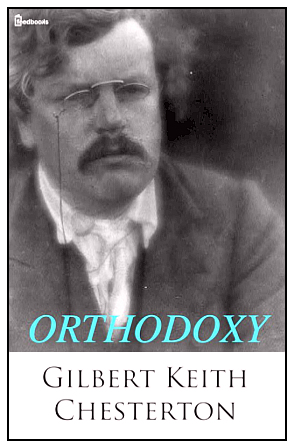
In his book Orthodoxy, G.K. Chesterton wrote: The modern world is not evil; in some ways the modern world is far too good. It is full of wild and wasted virtues. When a religious scheme is shattered (as Christianity was shattered at the Reformation), it is not merely the vices that are let loose. The vices are, indeed, let loose, and they wander and do damage. But the virtues are let loose also; and the virtues wander more wildly, and the virtues do more terrible damage. The modern world is full of the old Christian virtues gone mad. The virtues have gone mad because they have been isolated from each other and are wandering alone. Thus some scientists care for truth; and their truth is pitiless. Thus some humanitarians only care for pity; and their pity (I am sorry to say) is often untruthful.
Pseudo-pity and overblown compassion today are being pushed as reasons for allowing and promoting illegal and/or immoral behavior. Recently I saw a meme on eX-twitter: "Don't kill me just because I came here illegally so my children could have a better life!" This is how the full facts can be distorted or ignored in order to stir the virtue-signalling pseudo-pity that justifies a disregard for laws meant to protect society. The same tactic is used to promote unmarried and same-sex couples "living together" (fornicating). Genuine compassion keeps in mind what not only satisfies or gratifies individuals, but also and more importantly what is best for society in the long run.
When "the virtues are let loose" they become unbalanced. We know what happens when a washing machine is unbalanced: it begins making terrible noise as it bounces around the floor, banging into other objects. It's even worse when a car engine or wheels are unbalanced, and often fatal when a jet engine is unbalanced. Thus, when we push one of the virtues to an extreme, it's no longer a virtue, it distorts into a vice.
One of my favorite verses in the Psalms is – "Mercy and truth meet together. Righteousness and peace have kissed each other" (Ps.85:10). This passage aptly illustrates the harmonious balance of various virtues: mercy counterbalanced by truth, righteousness (justice) coupled with peace. Seeking peace at all costs can easily endanger the continued existence of society. In the same way, tolerance of sexual immorality in the long run leads to the extinction of a nation, as the upcoming demographic implosion indicates.
"The law of the Lord is perfect, restoring the soul. The testimony of the Lord is sure, making wise the simple" (Ps.19:7).
The motto in our newsletter's heading, "The right to believe and the right to life are inseparable: Right belief in a loving God enables us to love our neighbor!" doesn't mean that whatever we want to believe is right. That's confusing the two different meanings of the word "right." Rather, it shifts the responsibility for choosing the right beliefs from the state to the church, the family, and the individual. Freedom of religion implies responsibility!
We need to understand where the right to believe – freedom of religion – sprang from. For thousands of years, it was determined by the tribe or the king or emperor. But with the coming of the Messiah, the Christ, it shifted from being just an external commandment to worship Yahweh, the Jewish nation's God, or the gods of the Gentile nations and peoples. Christianity insisted (and still insists) on the right and duty of each family and each person to search and strive for sincere faith in the true God.
In the article "Reclaiming the Real Definition of Religious Freedom" we learn that modern political discourse often weaponizes religious freedom as a cover for partisan agendas and culture wars rather than upholding genuine constitutional rights. The article criticizes the current administration and some Christian leaders for supporting policies that prioritize religious exemptions while simultaneously undermining the rights of minorities, immigrants, and people of color.
The article notes that these political efforts often violate the constitutional separation of church and state by allowing federally funded agencies to discriminate based on religion and identity. The author calls upon Christians to reject "false framing" and instead advocate for a version of religious liberty that aligns with Christian teachings on universal human dignity. Readers are encouraged to take actionable steps, such as lobbying representatives, challenging discriminatory government policies, and working toward a return to historical Christian sexual ethics.
Freedom of conscience and the free exercise of religion means that the state must not coerce its citizens to love our neighbors – the poor, the disabled, and the elderly. But when the state takes over this role of providing financial support for those most in need of loving attention by taxing us, we no longer have the freedom to do so or not to do so: we have lost the free exercise of religion.
And in fact, when the state takes over this role, it most often insists that it must be kept separate from any particular religion or beliefs: thus, it coerces the disbelief in any religion. This is the dilemma of a secular society in which religious belief has been robbed of the right to express that belief in action! And the "loving attention" part of it turns into bureaucratic rules of entitlement: do you check all the right boxes on the form?
As the heading on our "DAILY PRAYERS" web page shows, there must be a "Why?" to our prayer life. If it's merely to perform a religious duty, it becomes an empty charade, window dressing to convince ourselves that we're on right terms with God. But we must demonstrate our love for God by loving our neighbors, and especially those most in need of loving attention – the poor, the disabled, and the elderly (often the same). That's why "Build the ARC!" comes right after the "Why?" in our "Daily Prayers" heading. Go to our "Morning Prayers" web page to see how to join our "live" Daily Prayers at 7 a.m. every day – and do the "Why!"
(This essay is from a blog article that I posted on July 5, 2013. I'm deleting that old blog site, so I'm preserving the article here.)
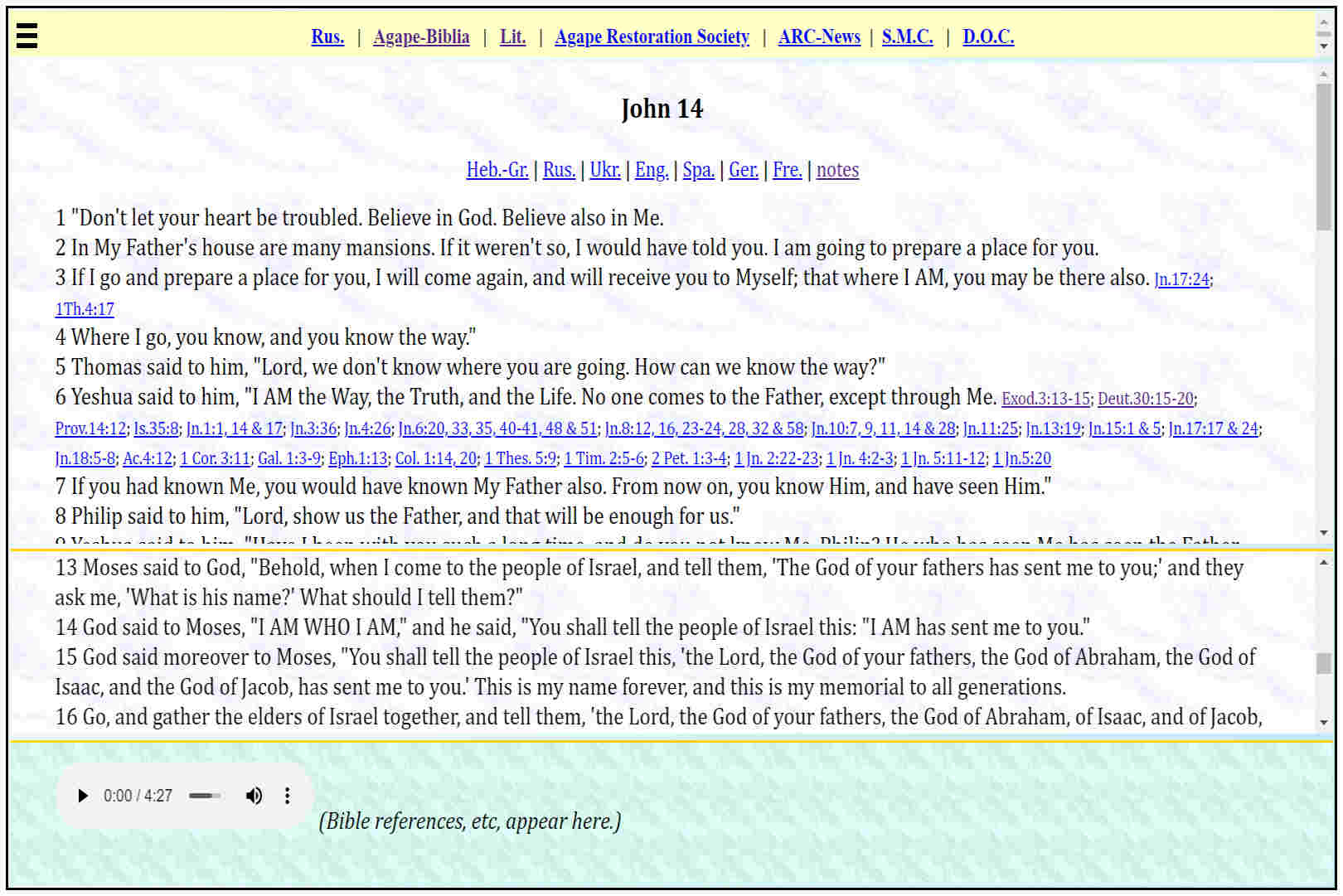
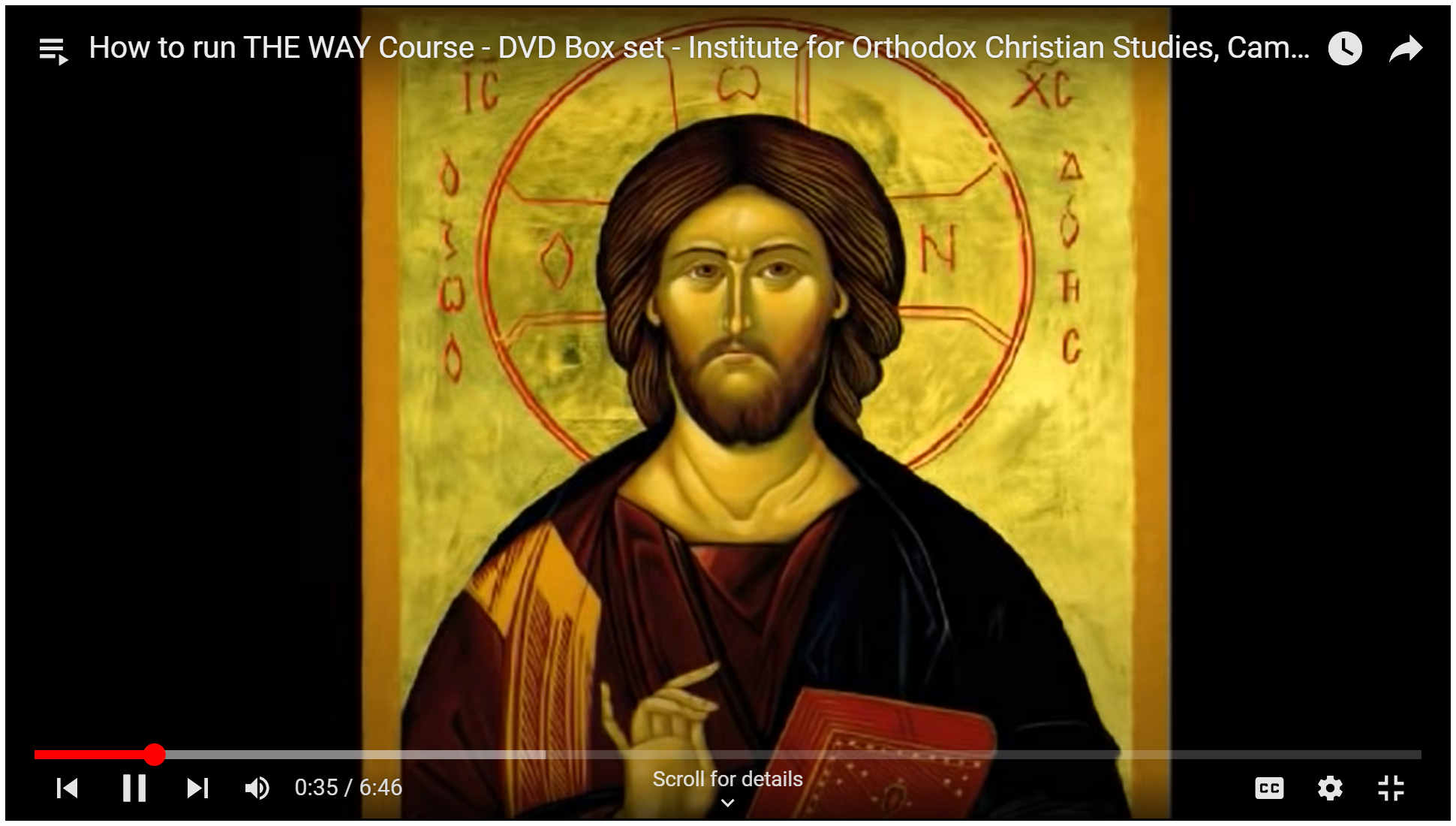
Simply put, "Yes." There is a Right Way. Jesus Christ established His Church upon the apostles and their confession of Him as the Christ, the Messiah - God's Anointed One. He is "the Way, the Truth and the Life" - click on the photo for details.
But what about all the denominations and confessions that call themselves Christian? Aren't these all acceptable variations of the Church? To answer that, we need to consider a few other questions:
First, did Christ say to Peter: "Upon this rock [Peter's confession that Jesus is the Christ, God's Anointed One] I will build a multitude of churches, each with a different set of doctrines and varying ways to worship me"? Of course not! Christ used the singular form, "Church" - one set of doctrines and one way to worship.
That's what a "church" (denomination or confession) is, or at least should be: the One Way. Only one truth can be true, the others are either a little untrue or way off-course. The alternative, that you can have your truth and I can have mine, that there are absolutely no absolutes and that's the absolute truth, is a logical absurdity. And yet, many modern denominations have fallen into this kind of relativism.
Secondly, didn't the organized church "go off the rails" when the last apostle died, or at least sometime shortly after Emperor Constantine adopted Christianity as the state religion? The notion of setting up the first-century Church as the ideal is commonly held among modern Protestants. The earlier Protestant reformers - Wycliffe, Luther, Zwingli, Calvin - however, were protesting not against the original Church of the first ten centuries, but rather against the more recent excesses and corruption of the Roman papacy such as total celibacy of the priesthood (that led to fornication and child molestation), selling forgiveness of sins ("indulgences") and selling higher clerical positions to the highest bidder ("simony").
The early reformers looked back longingly to original Christianity, the undivided Church of the first ten centuries, and its doctrines and form of worship. The Roman papacy had broken away from it in 1054 A.D. and eventually set itself up as the "Holy Roman Empire." During the Crusades, Rome attacked and plundered Constantinople, the capital of the Eastern Roman Empire, leaving it weakened and susceptible to the Muslim Turks, who finally captured the city in 1453 A.D. and renamed it Istanbul.
Hagia Sophia, the Cathedral of Holy Wisdom, was converted into a mosque, and the Patriarch of Constantinople was effectively put under house arrest, limited to just a few acres of territory, and stripped of any involvement in society. The "Orthodox" Church, the place of "right worship" (that is what "ortho-doxy" means) essentially ceased to function as an independent entity. Orthodoxy in Russia was also subjugated to the Muslim Mongols at about the same time. Thus the early reformers had nowhere else to turn, no alternative but to set up their own churches.
But after the "Magisterial Reformation" - so called because it retained the form of worship, doctrines, and hierarchical structure of early Christianity - came the "Radical Reformation" led by Thomas Muentzer, Andreas Karlstadt, Menno Simons, and others. These radicals, as the name implies, strove to do away with all hierarchy, liturgical forms of worship, and ornate art in church buildings. No bishops, no clerical garb, no set prayers, no statues or pictures of the saints... nothing was to be found in their church buildings except four plain walls, pews, and a pulpit. Some even went so far as to do away with seminary-trained, ordained pastors. This was not just a reformation, but a revolution - a complete overthrow of the old order.
Gradually over the centuries, however, the ideas of the Magisterial and Radical Reformations began to merge. Today we have denominations with no bishops and with pastors who are ordained with no seminary education (perhaps a two-year Bible college course after high school, but even that isn't absolutely necessary). Multicolored banners with little or no Christian symbols replace pictures or statues of the saints.
Some denominations still use traditional hymns, a choir, and a pulpit. More popular, though, is to use a "worship team," an electronic keyboard, drums, and guitars, but no pulpit: the preacher sits on a high stool with a microphone in front of him, or walks around the stage using a wireless microphone. In warmer climes the preacher's official garb is sandals, Bermuda shorts, and a Hawaiian shirt; in cooler places, it's sports shoes, blue jeans and a pastel (light blue, yellow or pink is "in") broadcloth shirt with the sleeves rolled up. Off-the-wall songs are projected by PowerPoint slides, often mixed together with video shows.
The result is a confusing medley of secular entertainment with an admixture of a few religious-sounding nice aphorisms such as "love one another," "acceptance" and "respect diversity." Thus the churches have become worldly and the secular world has become "churchy," all with little or no resemblance to original Christianity, the Church of the first ten centuries.
But what keeps the true, right-worshiping Church from either the tyranny of the papacy or the anarchy of the radical revolutionaries who think "It's every man for himself" (or "each person for themselves" if you prefer gender-less and ungrammatical English)? Are the only alternatives dictatorship or anarchy?
The early Church of the first ten centuries was organized by "godly men who are able to teach others," as St. Paul wrote to his disciple Timothy (2 Tim. 2:2). These "godly men" were called bishops, and they would meet together in councils in order to hash out problems that arose in doctrines and practice of worship. The infant Church of the first few centuries was certainly not ideal: it suffered from heresies and immorality, much like in later eras. In fact, ignorance of those early heresies - Gnosticism, Arianism, Nestorianism, Antinomianism, Modalism, Montanism, Universalism - that the early Church Councils condemned has tragically allowed many later would-be Christians to fall into some of these same errors.
Councils of bishops can sometimes get unruly: St. Athanasius punched out Arius for his heretical teachings. The iconoclasts at one time seized the majority and for a hundred years went about destroying icons, burning churches that contained them and even killing those who venerated the saints represented by icons. This was repeated, sadly, during the Radical Reformation.
But councils of bishops represent the best of the democratic process: godly men who are motivated by Christian principles of love and truth coming together to vote on issues of the day. Winston Churchill, when asked what was the worst form of government, replied: "Democracy... unless you consider the alternatives!" The alternatives to godly men - bishops - meeting in councils is either dictatorship of the papacy, or anarchy in which each man is a pope unto himself.
Does this mean that the Orthodox Church is perfect? No, it's still a work in process: bad apples do sometimes appear, but the Church's conciliar structure provides a self-correcting mechanism that preserves unity while avoiding heresy. Individual believers pray dozens of times in their worship, "Lord, have mercy!" because we confess that we are each "the chief of sinners." We know we must "first remove the beam out of our own eye, and then we can see clearly to remove the speck out of our brother's eye."
Yet at the same time, we acknowledge that Christ is the "head over all things for the Church, which is His Body, the fullness of Him who fills all in all" (Eph. 1:22b-23). The fullness of Christ is to be found not in individual believers, but in His Body, the Church.
 You really must read the article by the title in my headline! The author asked ChatGPT: "If you were the devil, how would you destroy America’s youth?" Its answers were unsettling and too familiar.


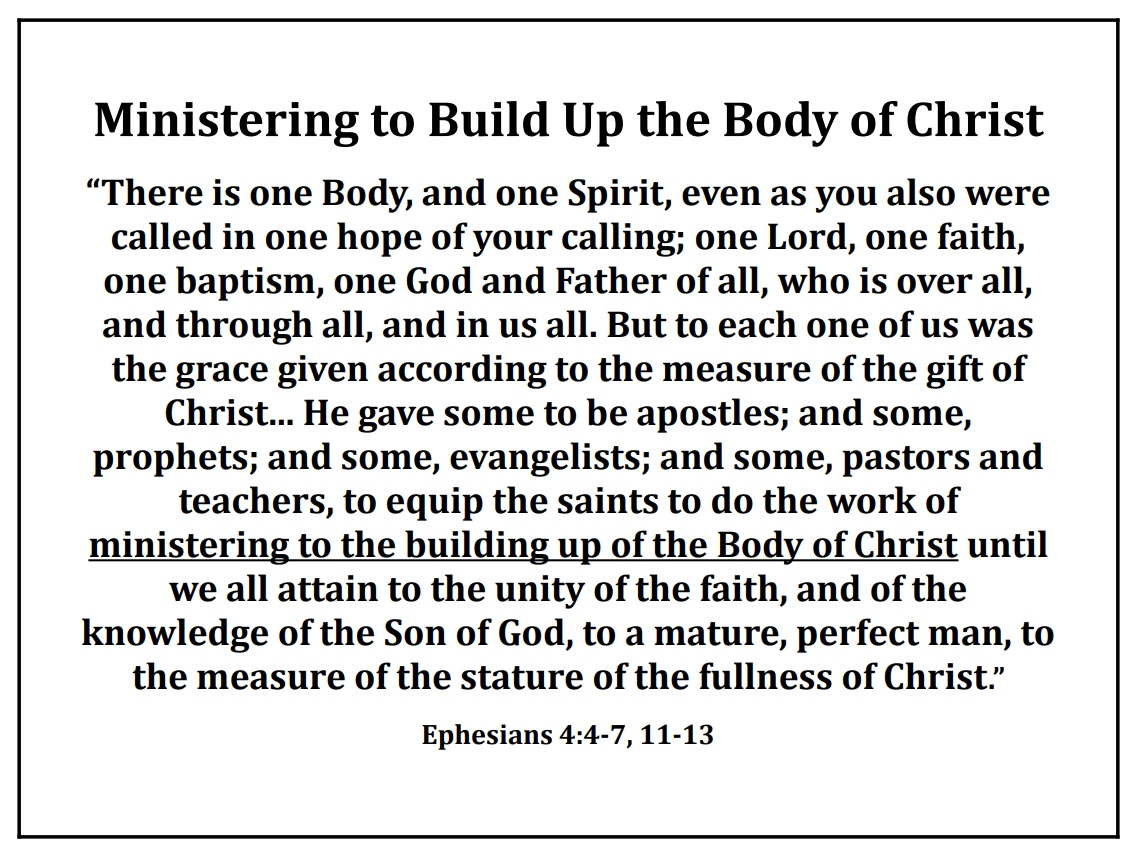 What is the driving principle of the Church... and your church? Is it just getting people saved, out of hell and into heaven when they die? Is it some kind of “eternal fire insurance?” As you read in our article "
 From the outset it is important to stress the need for local self-sufficiency in our Agape Restoration Communities. Although it is not necessarily harmful to help support poor and disabled people (